
Fields in Green County Property Tax Records
A Green County tax record mixes assessment figures with actual charges. The bill separates land, improvements, and total assessed value. It can show more. Estimated fair-market values, district information, credits, and prior-year delinquency often appear on the same statement, and field names here follow the state's example bill rather than a fixed Ascent screen layout. Ascent, the county-linked system, carries ownership, assessments, and taxes. The Treasurer fills the gaps. That office supplies bill copies, payment receipts, delinquency answers, and parcel history.
| Field | What It Shows | Where |
|---|---|---|
| Land, improvements, total | Assessed amounts used in the local tax calculation | Ascent / municipal assessor |
| Estimated fair-market value | Ratio-based estimate shown separately from the assessment | Tax bill / Wisconsin DOR guidance |
| Credits and indicators | School levy tax credit, other credits, and unpaid prior-year flag | Tax bill / Treasurer |
| Tax, delinquency, payment | Amount due, tax year, status, receipt, or payment history | Treasurer / municipal collector |
| Taxing district | Municipality and district context behind the bill | Ascent / tax bill |
The estimated fair-market value is not an appraisal. It will not predict a sale price either. Wisconsin's example bill derives the figure from the taxation district's average assessment ratio, and agricultural-use property does not follow every ordinary estimate field. A recorded sale price belongs in transaction records, not on the tax bill's assessed value.
Find a Green County Tax Bill by Parcel
Ask for a Green County bill with the parcel number and tax year in hand. The Treasurer handles that request. The office covers tax-bill copies, receipts, delinquency, parcel descriptions, transfers, splits, values, and map questions. A current Ascent result helps identify the parcel. The bill itself names the treasurer who collects each installment. Online payment carries a convenience fee. That fee is a payment cost rather than the price of a deed copy or public-record inspection.
- Identify the parcel number, municipality, and tax year in Ascent or a prior bill.
- Read land, improvement, and total assessment separately from the estimated fair-market fields.
- Check the bill for credits, prior-year unpaid tax, special charges, and the named collector.
- Request a bill copy or receipt from the Treasurer or municipal collector if the online result is incomplete.
- Assessed value
- The local value assigned to land and improvements for property-tax purposes.
- Mill rate / levy
- The district's tax rate and the amount it raises across its taxable property base.
- Homestead credit
- A Wisconsin state credit for qualifying applicants; check current eligibility and filing instructions with the state.
- Tax lien
- A legal claim associated with unpaid taxes; verify its status through the Treasurer and recorded documents.
Question a Green County Assessment With the Local Assessor
Green County publishes assessment guides and aggregate ratios. It also lists mill rates, parcel-combination forms, lottery-credit details, and revaluation explanations. No appeal calendar or form appears among them. Start with the municipal assessor instead. Ask that office for the assessment record. Ask also for the basis behind the land and improvement figures. Then get the review steps. A generic deadline from another Wisconsin municipality will not protect you. Confirm which deadline applies to that taxation district. Ask how an informal review differs from a formal board process.
Appeal window. The exact local dates and forms were not verified in the research. Confirm the current schedule with the municipal assessor before submitting evidence.
Green County Assessment Is Not the Final Tax Bill
Wisconsin keeps three numbers apart: the local parcel assessment, the district's overall assessment ratio, and the bill's estimated fair-market value. Land, improvements, and total assessed value come first. Estimated fair-market amounts and credits follow. A changed assessment says little by itself. The local levy, total taxable value, district rate, credits, special assessments, and other charges all move the final amount due. For agricultural-use property, the DOR guide notes the usual ratio method does not estimate every fair-market field the same way.
The Treasurer's document collection includes aggregate ratios and mill rates for local districts. Use the same tax year and district. Compare like with like. A payment receipt proves payment and nothing more. It does not release a mortgage or prove title to the parcel.
- Assessed value
- Local value assigned to land and improvements for taxation.
- Assessment ratio
- The ratio used by Wisconsin to compare local assessed values with fair market value.
- Levy
- The amount a local government raises through property tax across its tax base.
- Tax district
- The municipality and other taxing units applied to the parcel.
Green County Installments Have Different Collectors
A Green County bill can split its payment routes. The county lists the City of Monroe, City of Brodhead, the Villages of Albany, Belleville, and Brooklyn, and the Towns of Cadiz and Jordan as first-installment collectors. Green County collects every second installment. The bill names the recipient. Check that field before sending money. The same quirk explains why a neighboring property can carry a different payment office or tax-district code.
The Treasurer's office sits at 1016 16th Avenue in Monroe and opens on weekdays. Its work reaches far. The office handles delinquent and current real-estate taxes, payment history, bill copies, parcel descriptions, new parcel numbers, splits, assessments, and fair-market-value questions. Online payment adds a convenience fee. When a due date is close, ask the office for current payment instructions.
Ascent Tax-Search Fields Need a Current Check
The county calls Ascent its property ownership, assessment, and tax system. Its exact search controls stay undocumented. Treat the field table as a checklist, not a map of the current screen. Note any label and tax year you see. Then ask the Treasurer about missing fields. The county's statement that at least 15 years of property information is available covers county property information only. It does not date Tapestry deed coverage.
| Search or result field | Type / status | What Green County confirms |
|---|---|---|
| Owner name | Search option; live format unknown | County states owner-name search is available |
| Assessment and tax | Result group; exact labels unknown | Ascent covers assessments and taxes |
| Parcel / address | Search fields and required status unknown | Identify the parcel from a bill or county map |
| Payment history | Portal fields not verified | Treasurer handles requests for payment history and receipts |
Green County Tax Documents Explain Bill Fields
The Treasurer's documents page unpacks the parts of a Green County tax bill. Explanations cover aggregate ratios, mill rates, and tax-district codes. Lottery credit, parcel combination, and assessor contacts get their own write-ups too. That estimated fair-market value printed on the bill comes from the district ratio. It is applied to the assessment. It is not a new appraisal. The DOR property-owner guide also flags unpaid prior-year tax and available credits. Before trusting an old bill, check the tax year. Or check numbers that belong to a different parcel. Match the parcel number and district exactly.
The Green County Treasurer's property page rounds up local property-information resources. It covers payment resources for property records questions too.
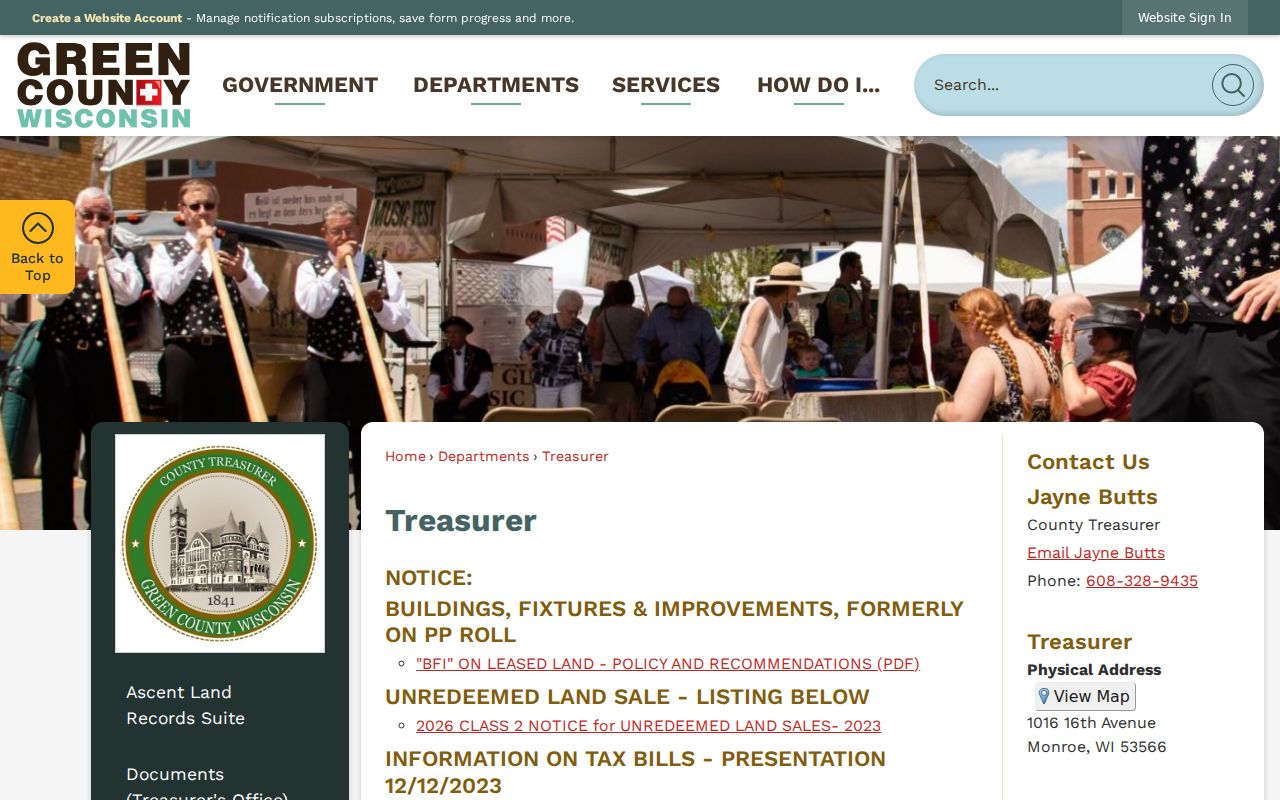
Green County's page steers tax questions to the proper office and links its property-information materials.
Green County Delinquency Can Lead to a Tax Deed
Green County lays out a clear timeline for delinquent parcels. Taxes go delinquent on January 1. In March the county starts working through parcels owing at least two years of taxes. Notices go out by mail in April. Qualifying parcels become eligible on May 1. Sale information is published afterward. Registration runs from August 1 through the Thursday before the auction. The public sale falls on the fourth Monday in August. The county's instructions specify a courthouse sale at 10 a.m. They also describe certified-fund requirements for the process. Verify the current notice each year before acting.
The separate tax-deed results table lists site address, parcel number, minimum bid, sale date, and final sale price. One 2025 example shows a Monticello parcel with a $22,750 minimum bid. It sold for $24,232.22. That gap matters. A minimum bid is the county's pre-sale figure, not the buyer's final price. A prior sale row also says nothing about the parcel's present title status.
Green County's current and prior tax-deed table provides parcel and sale details.
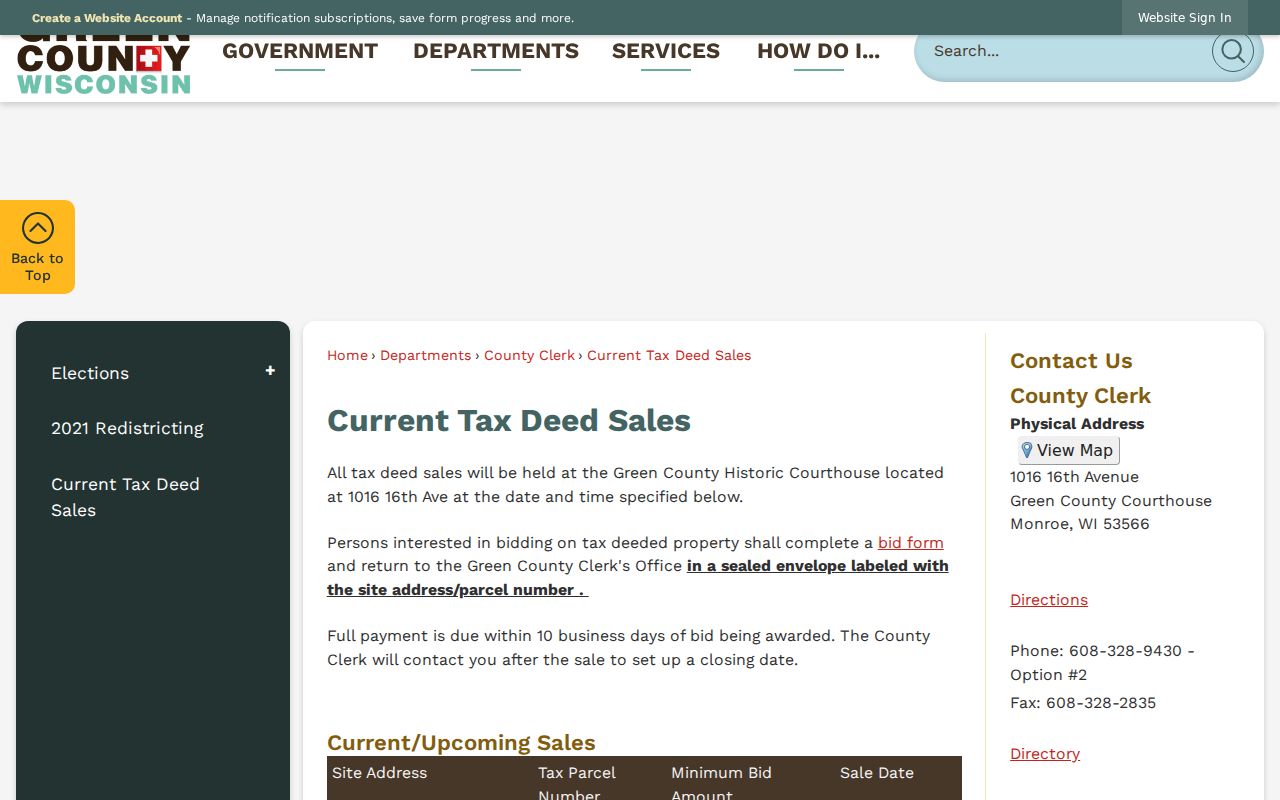
Carry the parcel number from any sale row into the later tax and recorded-deed records.
Request a Green County Bill or Payment Record
Missing a bill is a solvable problem. Give the Treasurer the parcel number, municipality, and tax year, and ask for a specific record: a bill copy, a receipt, the delinquency amount, or a payment history. If the first installment was paid locally, follow the collector named on the bill, since Green County only takes second installments countywide. Wisconsin Public Records Law, Wis. Stat. §§19.31–19.39, generally permits inspection and copying of existing public records, subject to exceptions. A custodian need not build a new report or chase a broad research question. The county's statement of at least 15 years of public property information makes the Treasurer the natural starting point for older tax questions. Assessment appeal deadlines, though, still require current local verification.
Green County Tax Bills Can Have Two Collectors
Who collects your installment can change mid-year. Green County's local instructions name the City of Monroe, City of Brodhead, the Villages of Albany, Belleville, and Brooklyn, and the Towns of Cadiz and Jordan as municipalities collecting the first installment themselves. The county handles second installments everywhere. Go by the collector printed on the actual bill for your parcel and tax year. A payment sent to the wrong office can post late even when the parcel number is right. A Monroe or Brodhead mailing address alone cannot tell you where an installment belongs.
Online payment carries a possible service fee. That fee belongs to the payment channel, not to any public-record copy request. Save the confirmation and check the tax year and parcel number on the receipt. If the payment history lags, ask the collecting office whether the transaction posted before assuming an unpaid balance or a title defect.
A Green County tax statement also separates land assessment, improvement assessment, total assessed value, estimated fair-market value, district ratio, credits, special charges, and prior-year unpaid tax. Those fields describe one year's tax calculation. They do not report a negotiated purchase price. And a payment receipt neither releases a mortgage nor proves who holds title as owner of record.